The 4.67% Ceiling: Why Patient Borrowers May Be About to Get Paid
The bond market just flashed a signal most buyers will never see — and by the time it makes the evening news, the window it's pointing to may already be closing. Here's what I'm watching, and why.
Scorecard update · July 30, 2026 — tested twice, still holding
Since this post, the 10-Year has closed above 4.67% on two sessions — 4.71% on July 23 and 4.69% on July 24 — and was rejected back under both times, to 4.65% and 4.61%. On July 29, after the Federal Reserve held rates and crude jumped roughly 6%, it closed at 4.67%: the number called here, ten weeks later.
I read that as the level tested and holding, rather than broken — a level breaks when the market accepts a new range above it, and two sessions four basis points over isn't that. But you can see the two closes above the line as well as I can, and you're entitled to score it differently. So that you don't have to take my word for it next time: I'll consider this call broken on two consecutive weekly closes above 4.75% — not an intraday spike, not a two-day poke. Written down in advance, on purpose. The full scorecard — including the argument against my own position — is in The 10-Year Watch No. 5.
Daily 10-Year constant-maturity yields as published by the Federal Reserve (H.15 Selected Interest Rates; FRED series DGS10), rounded as published. Third-party market data, not rate quotes. The original post below is unchanged — the record is the point.
The Number Nobody's Talking About
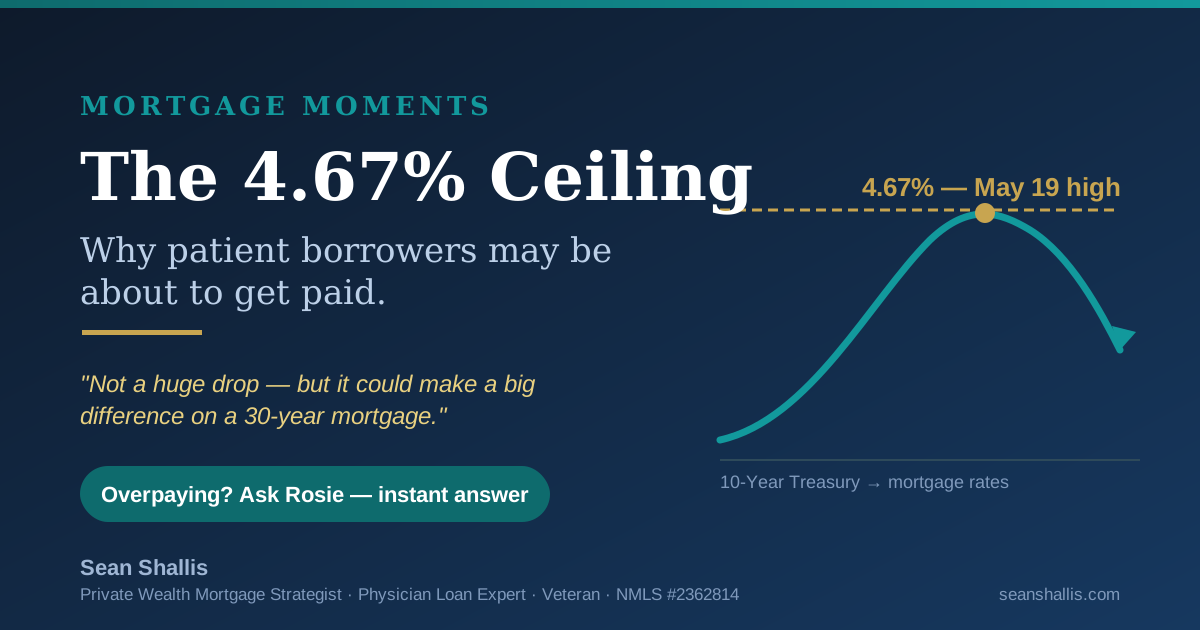
On May 19, the 10-Year Treasury closed at a yield of 4.67% — the high-water mark of this cycle. If you don't follow the bond market, that number means nothing to you. If you're shopping for a mortgage — or carrying one — it might be the most important number of your year.
Here's why: mortgage rates don't follow the Fed. They follow the 10-Year Treasury. When that yield climbs, mortgage rates climb. When it rolls over, mortgage pricing improves — often before most borrowers ever hear about it.
What I'm Seeing Right Now
In my read of the market, we have a very good chance of being at a short-term high in the 10-Year Treasury. I wouldn't be looking for yields significantly higher than what we're seeing today. If the 10-Year holds under that May 19 closing high of 4.67% — and I believe there's a strong case it will — then 4.67% may very well be the topside of the curve for the foreseeable future.
Translation for everyone who doesn't read bond charts for fun: the ceiling may already be in. And when the ceiling is in, the interesting question isn't “how much worse can it get?” It's “what happens on the way down?”
So I'm putting it on the record — call this the start of The 10-Year Watch: I believe 4.67% was the top, and I'm willing to be publicly wrong about it. I'll keep score right here on Mortgage Moments as the market plays out. Most loan officers won't stick their neck out on a call like this. I'd rather plant a flag and be accountable to it.
The Bottom Line, In One Sentence
It's not a huge drop in interest rates I'm expecting — but on a 30-year mortgage, it doesn't take a huge drop to make a big difference.
Who This Signal Matters For
Buyers currently shopping
Patience is a position. If the topside of the curve is in, the buyers who are prepared — pre-approved, documents ready, strategy set — are the ones who capture the window when it opens. The unprepared read about it afterward.
Homeowners with a rate above today's market
If you closed in the last few years, there's a real chance you're overpaying right now — and an even better chance a re-check makes sense if this signal plays out. Most homeowners have no idea where they stand.
Veterans & VA-eligible borrowers
As a veteran myself, this one's personal: VA pricing moves with the same curve, and the VA interest-rate-reduction pathway (IRRRL) makes acting on an improved market simpler than most veterans realize.
Anyone building — construction-to-permanent
A one-time-close construction-to-perm loan locks your permanent financing while you build. If the curve behaves the way I think it might, the timing conversation on a build just got a lot more interesting.
What I'm Not Going to Tell You Here
What I can't do in a blog post is tell you what this means for your rate, your home search, or your current mortgage — because that answer depends on your loan amount, your credit profile, your timeline, your property, and what you're paying today. Anyone who gives you a one-size-fits-all answer to that question is selling, not advising.
But the answer exists, it's specific to you, and it takes about 90 seconds to get:
Are You Overpaying On Your Mortgage?
Get Your 30-Second Rate Verdict — just ask Rosie.
Free. No credit pull. No forms. Rosie checks your rate against the live market and gives you a straight verdict: move, wait, or stay put — and she'll tell you to do nothing if that's the right call. That's the point.
Why Listen to Me on This?
I've spent 30 years and over $1 billion in closed volume watching this exact curve — as a Private Wealth Mortgage Strategist, a physician lending specialist, a U.S. veteran, and a former realtor who's sat on both sides of the transaction. I don't sling loans and rates. I build Wealth Building Loan Strategies — lowest possible rate, least fees, highest lender credits — and timing the market curve correctly is one of the levers that makes that work.
The signal is on the table. What you do with it — and whether it reaches you in time to matter — is a 90-second question away.
Related: Points, Credits & the Wealth Building Loan Strategy · ARM or Fixed? · Construction-to-Permanent Loans · VA Loans
Sean T. Shallis · Private Wealth Mortgage Strategist · NMLS #2362814. This post reflects the author's personal market opinion as of the publication date and is for educational purposes only. It is not a rate forecast guarantee, a commitment to lend, an offer of credit, or financial advice. Market conditions change without notice. Treasury yield references are public market data. All loans subject to credit approval. Contact Sean for a personalized analysis of your specific situation. Equal Housing Lender.